Scratch Repeat Hello

0.5s 256M

In Scratch, you can ask the user to enter \(n\), store the answer in a variable named n, and then put an action inside a "repeat n times" block to make the computer do the same thing again and again.

The Scratch program below is executable. It reads n, and then says Hello, AACPSCHOOL! exactly n times.
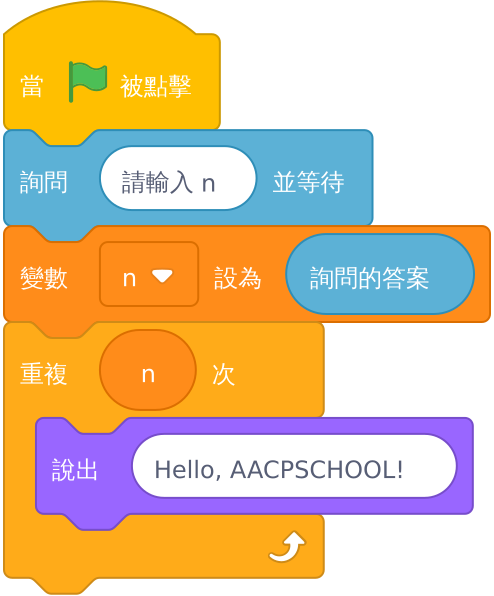
Please implement the same behavior in C++: read \(n\), and then print Hello, AACPSCHOOL! on \(n\) lines.

Input

The input contains one line with an integer \(n\).

Constraints

  • \(1 \le n \le 100\)

Output

Print \(n\) lines.

Each line must be exactly Hello, AACPSCHOOL!. The uppercase and lowercase letters, punctuation marks, and the space after the comma must all match.

Sample Input 1

3

Sample Output 1

Hello, AACPSCHOOL!
Hello, AACPSCHOOL!
Hello, AACPSCHOOL!

Sample Input 2

1

Sample Output 2

Hello, AACPSCHOOL!

Sample Input 3

5

Sample Output 3

Hello, AACPSCHOOL!
Hello, AACPSCHOOL!
Hello, AACPSCHOOL!
Hello, AACPSCHOOL!
Hello, AACPSCHOOL!

Problem page help

Keyboard shortcuts

Main features

  • Sample tests — Runs the sample cases bundled with the problem and auto-compares against the expected output.
  • Custom test — Run your code with your own stdin. Optionally tick the "Compare with expected (diff)" box to verify against expected output line-by-line.
  • Template — Paste the default code template you set on your profile page.
  • Collab — Edit this problem together with classmates in real time.
  • Auto-draft — Editor contents auto-save to your browser every 1.5 seconds (per account / problem / language).
  • Submit — Send your code to the judge for grading; returns AC / WA / TLE etc.

Limits

  • Source code: at most 65,536 characters
  • Custom test stdin and expected output: at most 1 MB each (≈1 million characters)
  • Custom test: about 1 request per 3 s per user (sample test: 1 per 1 s)
  • Custom test has a 15 second wall-clock cap; sample tests use the problem time limit, the same as the official judge
  • Interactive problems do not offer custom test (cannot simulate interaction with the judge).
  • Submitting has no rate limit, but rapid repeated submissions on the same problem are treated as score farming.