蒐集寶石 (APCS 2024-10 中級)
1.0s 256M小田設計了一個機器人來玩蒐集寶石的遊戲,遊戲的場地是一個 \(M \times N\) 的二維陣列,每個元素 \((i, j)\) 對應在第 \(i\) 橫列第 \(j\) 直行的格子,其中橫列由上而下,直行由左往右,皆由 \(0\) 開始編號。某些格子是牆壁,機器人無法進入,其他的格子機器人可以進入,這些格子內有若干寶石,但某些格子的寶石數量可能是 \(0\),場地四周視為被牆壁包圍,也就是機器人不能走出界外。遊戲開始時,機器人從編號 \((r, c)\) 的格子開始,初始的方向為面向東方(右方),初始得分與擁有的寶石數量皆為 \(0\)。機器人會記錄目前的得分以及行進的方向。機器人的行動規則如下,請計算出機器人在停止時所獲得的寶石數量,其中 \(K\) 是一個輸入的正整數:
- 如果走到的格子內無寶石,則停止遊戲;否則
- 將得分加上該格子目前的寶石數量,並取得一顆寶石。該格子的剩餘寶石數量就會減少一顆;
- 如果總得分是 \(K\) 的倍數,則向右轉(順時針轉 \(90\) 度);
- 若前方是牆壁或者前方是界外,則向右轉;持續本步驟直到前方的格子在場地範圍內且非牆壁;
- 進入前方的格子,並回到步驟 1 繼續。
請注意,在原地右轉時並不算再次走到該格子。
以下圖為例,場地是一個 \(4 \times 5\) 的二維陣列,起點在 \((2, 1)\),起始方向朝東,假設 \(K = 4\)。機器人一開始會行經 \((2, 1) \rightarrow (2, 2) \rightarrow (2, 3)\),此時得分為 \(3 + 2 + 3 = 8\),為 \(K\) 的倍數,因此會右轉,方向改為朝南。接下來往南一步走到 \((3, 3)\),此時得分為 \(11\),但往前是界外,因此會右轉朝西,此時前方 \((3, 2)\) 的位置為牆壁,所以繼續右轉朝北。
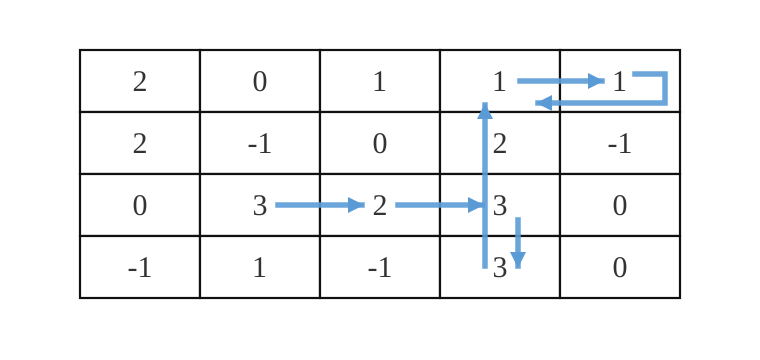
再前進時到達 \((2, 3)\),這個格子一開始有 \(3\) 顆寶石,但之前經過一次拿走一顆,所以只剩下 \(2\) 顆,故總得分為 \(11 + 2 = 13\)。接著會往北走兩次,總得分分別為 \(15\) 與 \(16\),在 \((0, 3)\) 時右轉到 \((0, 4)\),然後會右轉兩次朝西,最後走到 \((0, 3)\) 時,該格子的寶石已被取走,剩下 \(0\) 顆寶石,遊戲停止。總共獲得的寶石的數量即是停止前所走的總步數(\(7\) 步)加上起始位置的 \(1\) 顆,一共是 \(8\) 顆。
輸入格式
第一行有五個整數 \(M, N, K, r, c\)(\(1 \le M \le 100, 2 \le N \le 100, 2 \le K \le 20\)),其中 \((r, c)\) 為起始位置。接下來 \(M\) 行,每行有 \(N\) 個整數,為每一個格子由上而下,由左而右的值,其中 \(-1\) 表示牆壁,否則為寶石數量,寶石數量介於 \(0\) 到 \(K - 1\) 之間,同一行兩個數值間以一個空白間隔。起始點 \((r, c)\) 的位置保證不是牆,且起始點不會四周均無路可走,機器人最終一定會停下來。
輸出格式
輸出一個整數,為機器人所蒐集到的寶石數。
範例輸入 1
1 7 3 0 4
1 -1 2 1 2 1 0
範例輸出 1
5
範例說明 1
經過的格子依序為 \((0, 4)\)、\((0, 5)\)、\((0, 4)\)、\((0, 3)\)、\((0, 2)\),接下來到達 \((0, 3)\) 已無寶石。共取得 \(5\) 顆寶石。
範例輸入 2
4 5 4 2 1
2 0 1 1 1
2 -1 0 2 -1
0 3 2 3 0
-1 1 -1 3 0
範例輸出 2
8
範例說明 2
此為題目中之範例。
評分說明
輸入包含若干筆測試資料,每一筆測試資料的執行時間限制均為 \(1\) 秒,依正確通過測資筆數給分。其中:
- 第 1 子題組 60 分:\(M = 1\)。請留意 \(M = 1\) 時,如遇到右轉必然會連續轉兩次,也就是說右轉即是迴轉。
- 第 2 子題組 40 分:無額外限制。
題目來源
APCS 程式實作中級題本範例,程式實作 2024 年 10 月。
登入後即可撰寫程式並提交評測。
登入