造字程式 (APCS 2023-01 中級)
1.0s 256M給定一個長度為 \(K\)、只包含小寫英文字母的字串 \(S\)。造字程式會依照一個 \(1\) 到 \(K\) 的排列 \(P_1,P_2,\ldots,P_K\),重新排列字串中的字元。
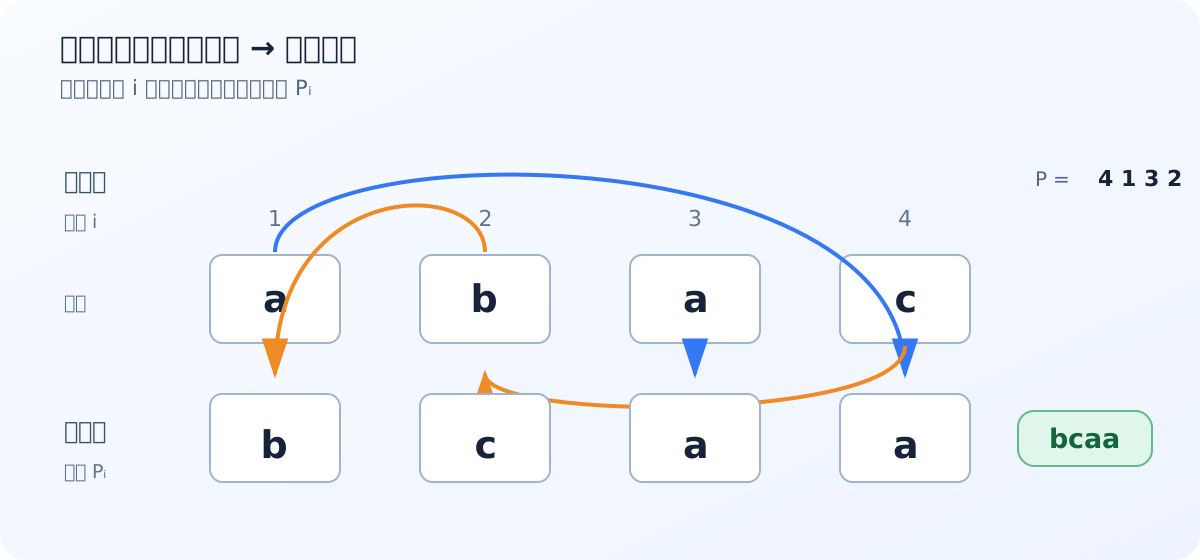
一次操作中,舊字串第 \(i\) 個位置的字元會被複製到新字串第 \(P_i\) 個位置。也就是:
\[\text{新字串}[P_i]=\text{舊字串}[i] \qquad (1\le i\le K)\]因為 \(P\) 是 \(1\) 到 \(K\) 的排列,所以新字串的每個位置恰好會收到一個字元。操作完成後,新字串會成為下一次操作的舊字串。
下圖以 abac 和排列 \((4,1,3,2)\) 示意位置的搬移。舊字串的第 \(1,2,3,4\) 個字元分別移到新字串的第 \(4,1,3,2\) 個位置,因此得到 bcaa。
程式會依序執行 \(Q\) 次操作,每次都有一個新的排列。給定整數 \(R\),請對新字串的前 \(R\) 個位置分別輸出一行:第 \(j\) 行由第 \(1\) 次到第 \(Q\) 次操作後,新字串第 \(j\) 個位置的字元依序串接而成。
輸入格式
第一行包含三個整數 \(K,Q,R\)。
第二行包含一個長度為 \(K\) 的小寫英文字串 \(S\)。
接下來 \(Q\) 行,每行包含 \(K\) 個整數 \(P_1,P_2,\ldots,P_K\),表示該次操作使用的排列。
限制
- \(1\le R\le K\le 20\)
- \(1\le Q\le 20\)
- \(S\) 只包含小寫英文字母。
- 每次操作的 \(P_1,P_2,\ldots,P_K\) 都是 \(1\) 到 \(K\) 的排列。
輸出格式
輸出 \(R\) 行。
第 \(j\) 行包含一個長度為 \(Q\) 的字串,依序表示每次操作完成後,新字串第 \(j\) 個位置的字元。
評分說明
本題共有兩個子題:
| 子題 | 分數 | 額外限制 |
|---|---|---|
| 1 | 60 | \(R=1\) |
| 2 | 40 | 無額外限制 |
範例輸入 1
5 4 1
abcde
2 1 3 5 4
5 1 2 4 3
4 1 2 3 5
3 1 4 5 2
範例輸出 1
bacd
範例解釋 1
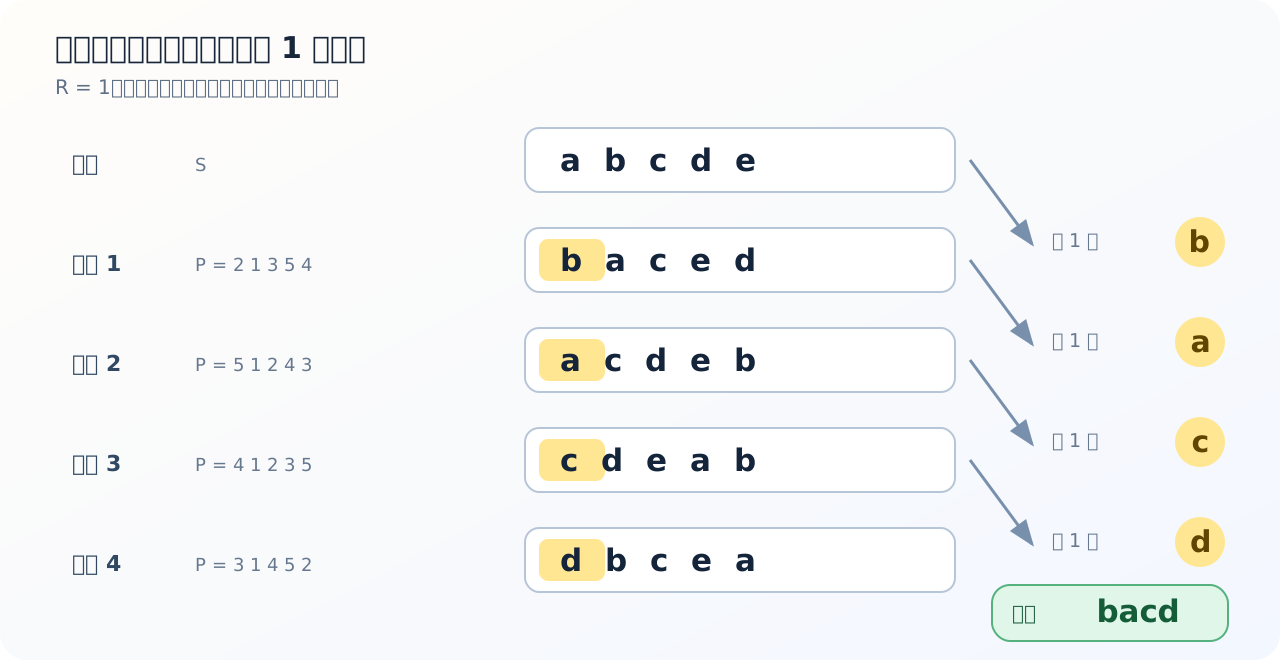
四次操作後的字串依序為 baced、acdeb、cdeab、dbcea。因為 \(R=1\),只需記錄每次操作後的第 \(1\) 個字元,依序得到 b、a、c、d,所以輸出 bacd。
範例輸入 2
4 3 4
abac
4 1 3 2
1 2 3 4
2 3 4 1
範例輸出 2
bba
ccb
aac
aaa
範例解釋 2

三次操作後的字串依序為 bcaa、bcaa、abca。由上到下逐一查看四個位置在三次操作後的字元,就得到四行輸出 bba、ccb、aac、aaa。
題目來源
2023 年 1 月 APCS 程式實作第 2 題:ZeroJudge j606「造字程式」。題目整理與範例說明另參考王一哲的 HackMD 題解。
登入後即可撰寫程式並提交評測。
登入